Do YC Requests for Startups matter?
Company data captured 28 October 2026. Historical company cases and testimony were reviewed 16 September 2026 unless otherwise stated.
RFS documents YC's interests and recruitment efforts. The quantitative analysis finds modest, uneven alignment with company descriptions. Broad predictive usefulness, effects on company formation and superior investment returns remain unproven.
Winter 2027: what the new list adds
The official page now has 107 requests across nine releases, up from 96 across eight. The eight earlier tab objects are unchanged in a full field-by-field comparison with our saved September extraction. Winter 2027 contributes all 11 additions. We captured it on 28 October; the exact publication date has not been established.
Our reading: YC is specifying more of the practical conditions needed for AI adoption—physical components, financing, trusted records, private deployment and specialist models. This extends earlier interests in manufacturing, government and model training. The writing-quality request is the clearest dedicated new topic in the retained modern corpus. These are thematic interpretations, not a quantitative measure of YC's overall investment allocation.
Several requests describe problems YC says it is already seeing among companies it works with. The new list can therefore be a synthesis of portfolio experience as well as an invitation for new applications. Repeated topics can reflect an evolving thesis rather than separate discoveries.
The requests contain forecasts, regulatory assertions, economic estimates and technical-performance claims. This update records them as YC's rationale; it does not independently validate launch-cost forecasts, domestic-content rules, benefits recheck schedules, tax-revenue estimates or model benchmarks. None is required to calculate the descriptive screen.
What already exists around the new requests
Four current YC profiles substantiate product overlap with older batch labels:
Profiles checked 28 October 2026. These are company-reported capabilities, not independently verified delivery or performance. Their older batch labels establish that YC's investments predate Winter 2027 as a batch, but do not date the current product or prove the product preceded the RFS publication. We observed these descriptions at this update, not in an immutable pre-publication capture. None is evidence of a company founded in response to this list.
Quantitative findings
The rerun uses a new pinned YC-OSS company snapshot, retrieved 28 October 2026: 6,341 public records, versus 6,203 in September. There are 2,508 records in Winter 2023–Winter 2027, including 179 Fall 2026 and six early Winter 2027 listings. Excluding both cohorts leaves 2,323 records in completed batches. Public records are not a census of investments, applications or company formation.
Fall 2026 is still in progress, despite its public count growing from 35 to 179, and remains outside headline comparisons. The six Winter 2027 listings are already visible before that batch; they cannot be treated as a completed outcome or as responses to this new list. The event-study output suppresses Winter 2027 target and follow-up results, rather than reporting a misleading zero. Fall results are marked exploratory/in-progress in the downloadable release summary and excluded from charts and sensitivity/timing headlines.
The screen retains the existing method: title/description TF-IDF compared with company descriptions and metadata; each request's threshold is set at the 95th percentile in three preceding batches. Updated descriptions, tags and the expanded request corpus change the fitted vocabulary and scores. This is a refreshed cross-section, not a point-in-time predictive backtest. Adding the new request text can alter older lexical scores; the September files remain the fixed historical comparison.
The default median remains 1.04×, with 46/83 requests above baseline, but the number at least twice baseline changes from four to six. Summer 2026 remains the strongest release at 1.34× median lift. These are lexical similarities, not audited product-fit rates.
Refreshed sensitivity and timing checks
Across nine specifications the median ranges from 1.01× to 1.10×; zero to nine requests reach 2×. Small differences in text or thresholds still alter which individual requests appear strongest.
Actual-label medians remain inside the alternative-timing ranges in both methods. Each benchmark uses 1,000 shuffled release assignments with the existing seed, preserving release counts and recalculating the preceding baseline. This does not show a broad advantage for the actual timing, and is not a causal randomisation test.
The balanced cohort remains the same 57 requests with three pre-batches and a named batch plus two completed follow-ups:
There is still no clean aggregate step change. Tags, repeated themes, selection, later pivots, release-date uncertainty and changing public disclosure remain confounders.
Extended lag analysis: S24 and W25 through +6 batches
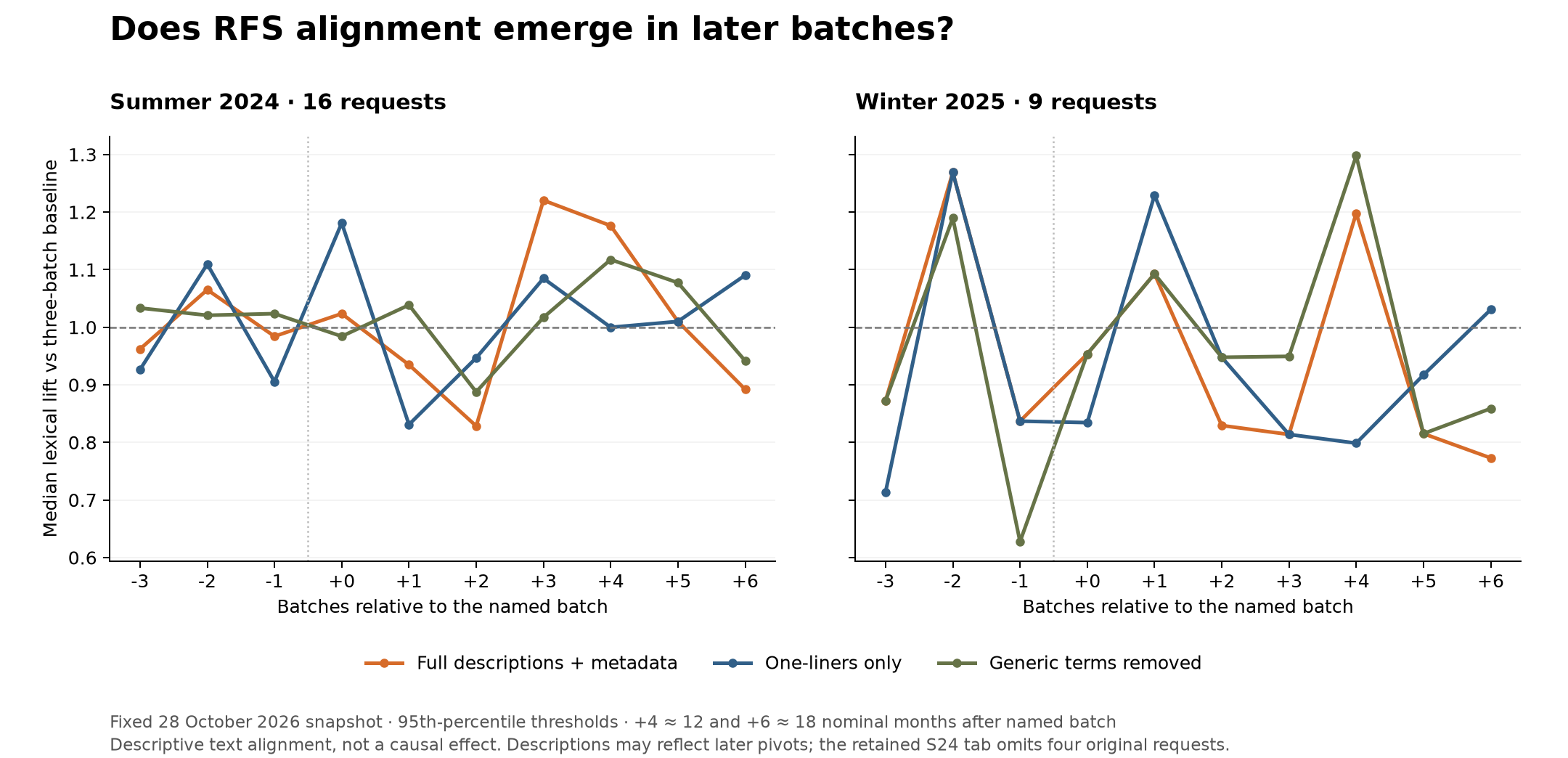
Added 28 October 2026. A longer window does not reveal a broad, durable delayed rise in this lexical screen. Both cohorts rise at +4 in the full-description method, but drop below their preceding-batch baseline at +6. The +4 rise is not stable across text specifications. A few individual themes show stronger later alignment.
This extends the existing descriptive analysis rather than estimating whether RFS caused later investments. It reuses the same pinned October snapshot, fitted text corpus, request weighting and threshold rules, so the +0 to +2 results reconcile exactly with the earlier output at published precision.
Cohorts and available timeline
The fixed cohorts are the 16 requests retained in today's Summer 2024 tab and all nine Winter 2025 requests: 25 request entries throughout every offset. Four categories in the original February 2024 announcement are absent from the retained S24 tab and remain outside this extension. Do not generalise it to the complete original 20-category list.
Both +6 endpoints are completed batches in the snapshot. Fall 2026 and Winter 2027 are excluded from outcome windows. Offsets are relative to the named batch, not independently established publication dates. On nominal seasonal batch-start months, +4 is about 12 months and +6 about 18 months. The S24 list was originally announced in February 2024, so these nominal intervals understate its actual time since publication. The study does not claim an exact day-level publication clock.
Main result: a +4 bump, not sustained cohort-wide growth
Median lift in the full-description/metadata method, with each request's threshold fixed at its three-preceding-batch 95th percentile:
For S24, 11/16 requests exceed baseline at +4, declining to 7/16 at +6. For W25, the equivalent counts fall from 6/9 to 3/9. The combined median is 1.18× at +4 and 0.86× at +6. Combining cohorts is descriptive: their calendar follow-ups overlap and their themes are related, so the 25 entries are not independent experiments.
A lift of 1.18× means the share of companies exceeding a lexical-similarity threshold is 18% above its constructed baseline. It does not mean 18% more companies actually satisfy an RFS or that RFS increased investment by 18%.
Does the result survive changing the text?
The same 95th-percentile thresholds are recalculated separately for each text specification:
At +4, S24's 1.18× full-text median is approximately 1.00× using one-liners. W25's 1.20× becomes 0.80×. At +6, one-liners give 1.09× and 1.03× respectively, while the two richer text specifications sit below baseline. There is no common sustained trajectory across these methods.
Nine specifications combine these three text definitions with 90th-, 95th- and 97.5th-percentile cutoffs. Across all nine, the combined-cohort median at +4 ranges from 0.82× to 1.40×; at +6, from 0.79× to 1.19×. These ranges describe method sensitivity, not statistical confidence intervals.
Pooling later batches instead of choosing a single endpoint
For each request, sum threshold-exceeding companies across the chosen window, divide by all companies in those batches, and compare that share with the request's fixed baseline. Then take the median across requests. This weights batches by their disclosed company counts and avoids averaging endpoint medians.
Full text, 95th percentile:
Across all nine specifications, the combined pooled +3-to-+6 median ranges from 0.84× to 1.08×; the narrower +4-to-+6 window ranges from 0.92× to 1.08×. Pooling does not uncover a large typical delayed increase. This conclusion is descriptive; no formal causal test or power analysis has been performed.
Individual request results
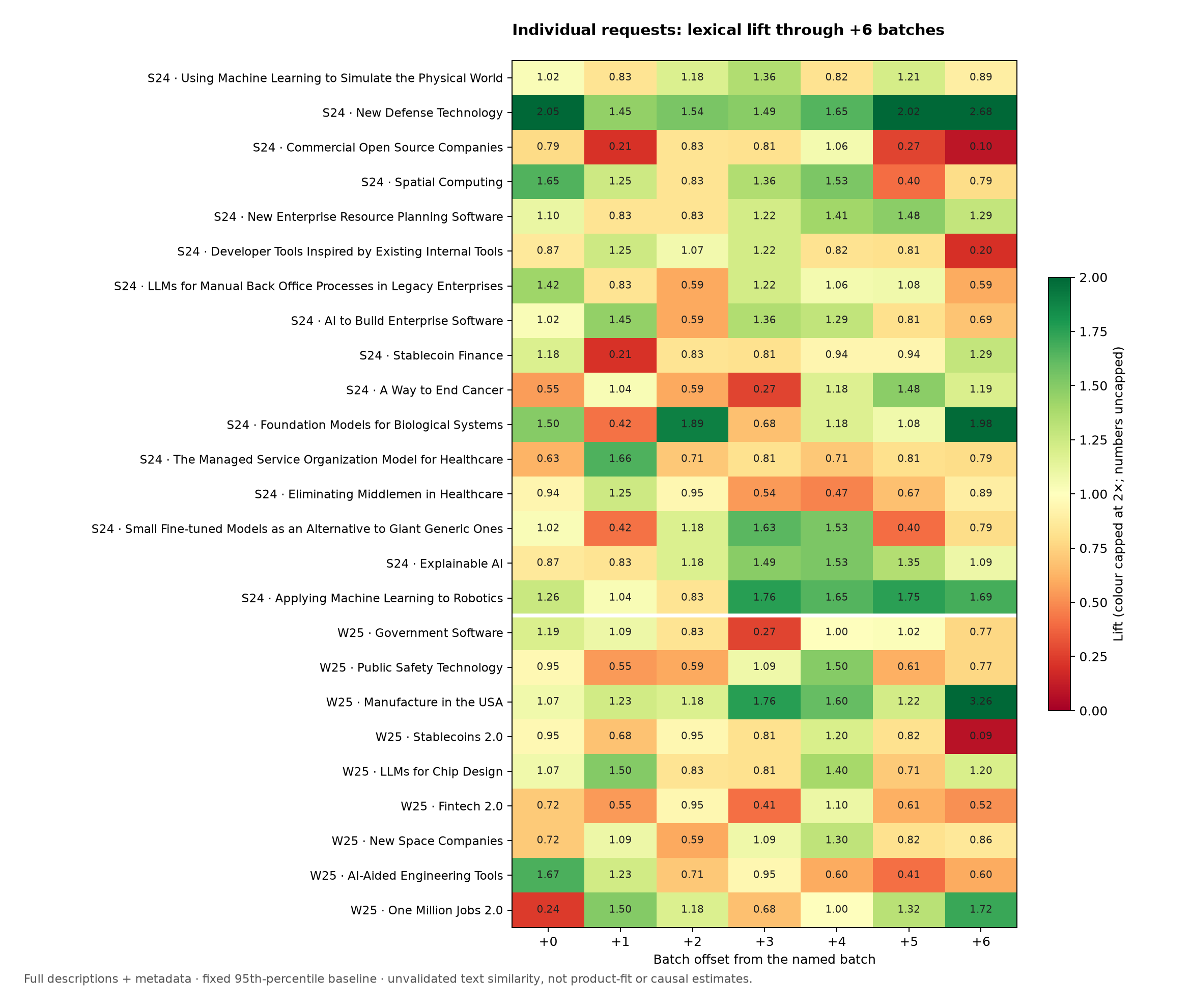
Pooled +3-to-+6 lift at the 95th percentile:
These three themes remain above baseline across all three text definitions. Defense already has 2.05× lexical lift in S24's named batch, so its later strength is not evidence of a newly emerging delayed effect. Robotics rises from 1.26× in the named batch to a pooled 1.71× later; US manufacturing rises from 1.07× to a pooled 2.03×. These are lexical results, not validated counts of companies responding to RFS.
For scale, at +6 the full-text threshold flags 27/197 Winter 2026 companies for the S24 defense request, 17/197 for robotics, and 38/229 Summer 2026 companies for W25 manufacturing. The underlying baselines are roughly 5% by construction. These are automated flags; prior company audits found material false positives.
Interpretation and remaining limits
The longer window weakens the argument that the initial modest aggregate simply reflects insufficient observation time. It does not show that RFS has no effect. Effects could vary by request, change applications without altering the selected batch, or be missed by lexical matching.
A company appearing several batches later may predate the request, pivot into the category, or have been influenced by a newer request. Current descriptions, improved tags, general sector growth, repeated themes and YC's selection all remain explanations. The pre-batch trajectories are uneven too, particularly W25's high -2 observation.
The fixed October TF-IDF corpus includes later descriptions; this is not a held-out forecasting exercise. The comparison has no matched unrequested topics, non-YC counterfactual or applicant denominator. We therefore report no causal effects, significance claims or investment-return conclusions.
Sources and validation
All 75 overlapping short-window comparisons match the earlier analysis at its published three-decimal precision. Validation checks cover fixed baseline shares, nonempty denominators, fixed cohorts, completed follow-up batches and the pinned source hash.
Sources are the existing pinned YC-OSS snapshot, the retained YC request corpus, and the original February 2024 announcement documented in the main report. The extension introduces no newly verified company-level classifications.
Historical evidence
The following source review dates to 16 September 2026. Company descriptions and directory status can change after that date.
Why RFS can matter even without creating companies
YC explicitly opened early interviews in February 2024 after founders reported that the new list inspired them to apply. It made that round available to all ideas, not only RFS matches.8 That documents a change in the application process, not a quantified acceptance advantage.
Michael Seibel described RFS as intended for existing builders and relevant domain experts. His biotech example was founders realizing YC would fund them and deciding to apply.9 In a first-person carbon-removal interview, Gustaf Alströmer reported increased applications, interest from engineers, and investor enquiries after the request; he described normal diligence and commercial expectations, and discussed Pachama and Prometheus as subsequent investments.10
Selection: interest is not an acceptance-rate estimate
An RFS can affect selection indirectly by changing who applies, even when reviewers apply the same standards. Historical YC guidance says applicants need not select an RFS category; Kat Manalac said category choice itself did not affect chances.11 That is evidence about declared practice in that period, not an audit of every current selection decision.
- Recruitment effect: more relevant teams enter the applicant pool.
- Composition effect: more accepted teams in a category because more good teams applied.
- Preference effect: equally qualified applicants become more likely to be accepted because the category is newly favoured.
- Readiness effect: RFS applicants could be earlier, later, or differently qualified than other applicants.
- Reviewer effect: a partner's knowledge, enthusiasm, or connections could influence evaluation without an explicit category quota.
- Pivot effect: teams move toward a requested theme after admission. Current directory descriptions may reflect this rather than the original application.
- Presentation effect: a team relabels an existing product using RFS vocabulary. This produces lexical alignment without product change.
The observed count is the product of several processes:
public matches ≈ relevant applications × acceptance rate × disclosure rate × match classification
Every term can change. Batch matching observes only the result.
RFS can influence the applicant pool. Public portfolio data cannot isolate a preferential-selection effect.
Leading indicator, lagging indicator, or feedback loop?
YC's February 2024 explanation says requests emerged from discussions about the current batch, working ideas, pivots, and gaps.3 The process is therefore partly informed by developments already underway.
The following examples illustrate different directions of influence. Descriptions are from the fixed directory snapshot and can contain later pivots.1
Investors: useful sourcing context, unproven alpha
Specter published a May 2025 landscape mapping more than 200 existing startups to the 14 Summer 2025 requests. This demonstrates a commercial use of RFS for investor discovery, not improved returns from that use.13
The list is public, so it offers no exclusive information by itself. Whether it improves investment returns depends on expertise, access, entry price, ownership and company performance. Public category funding totals do not establish an investment advantage.
Winners and direct RFS attribution
Five levels of evidence must be kept separate:
- A company's current description resembles a request.
- Its founding or application followed publication.
- A founder says they read the request.
- A founder says it changed their founding, application, hiring, or product decision.
- A verified economically significant outcome followed that documented influence.
Levels one and two are easy to find. They do not imply levels four and five. Founder testimony is stronger evidence about behaviour but still cannot perfectly establish what would have happened without RFS.
- Pachama and Prometheus are historical carbon-removal examples. The carbon-removal partner interview links the request to increased applications and discusses both later investments. It does not establish that either founder created the company because of that RFS or quantify returns.10
- Ginkgo is a directly attributed application case. YC says its founders read the biotech RFS and became interested in applying. The technology predated YC by years, and the company later listed publicly. This substantiates recruitment influence on a significant company, not RFS-caused formation or verified realized investment returns.21
- Airbnb and Dropbox cannot validate later numbered requests. Their YC batches were Winter 2009 and Summer 2007 respectively; Dropbox plainly predates the numbered corpus, and Airbnb was already admitted before the recovered mid-2009 material.14
- Coinbase cannot be credited to the 2024 stablecoin request. Its batch was Summer 2012. Broad retrospective crypto alignment is different from following that request.15
- Cruise is a timing trap. It was Winter 2014, before the March 2014 Breakthrough Technologies request. Later hard-tech retrospectives are not direct-origin testimony.14
- A celebrated financing is not a realized winner. Large raises and private valuations do not establish investor cash returns or customer success.
- An acquisition label is insufficient. A sale can range from a large return to an acquihire or distressed outcome; transaction terms and ownership matter.
- Failures belong in the historical sample. NewsTilt was a YC-backed journalism startup that closed eight months after founding. Its founder described weak traction, communication problems, and lack of intrinsic journalism motivation. This is a thematic counterexample to an easy journalism-success story, not a proven RFS-induced failure.16
A claim such as “RFS created YC's winners” is currently unsupported.
What the data cannot establish about outcomes
The modern requests are too recent to judge realised venture returns. Public directory status does not establish product-market fit, commercial success or investor proceeds. Funding, valuations, acquisitions and public listings measure different things.
An unchanged median also leaves the probability of exceptional outcomes unresolved. Company age, sector capital requirements, missing funding data and investor entry terms complicate comparisons. This study does not provide an age-matched RFS/non-RFS outcome panel.
Existing public funding analysis
The nrjshka project uses 66 themes, a June 2, 2026 snapshot, automated classifications, and partial funding coverage. It reports no age-matched uplift among nine eligible themes and acknowledges $500,000 floor estimates.18 Its statement is a useful comparison, not an independently verified outcome finding.